
That Time in the Rain
This is what fall sounds like to me

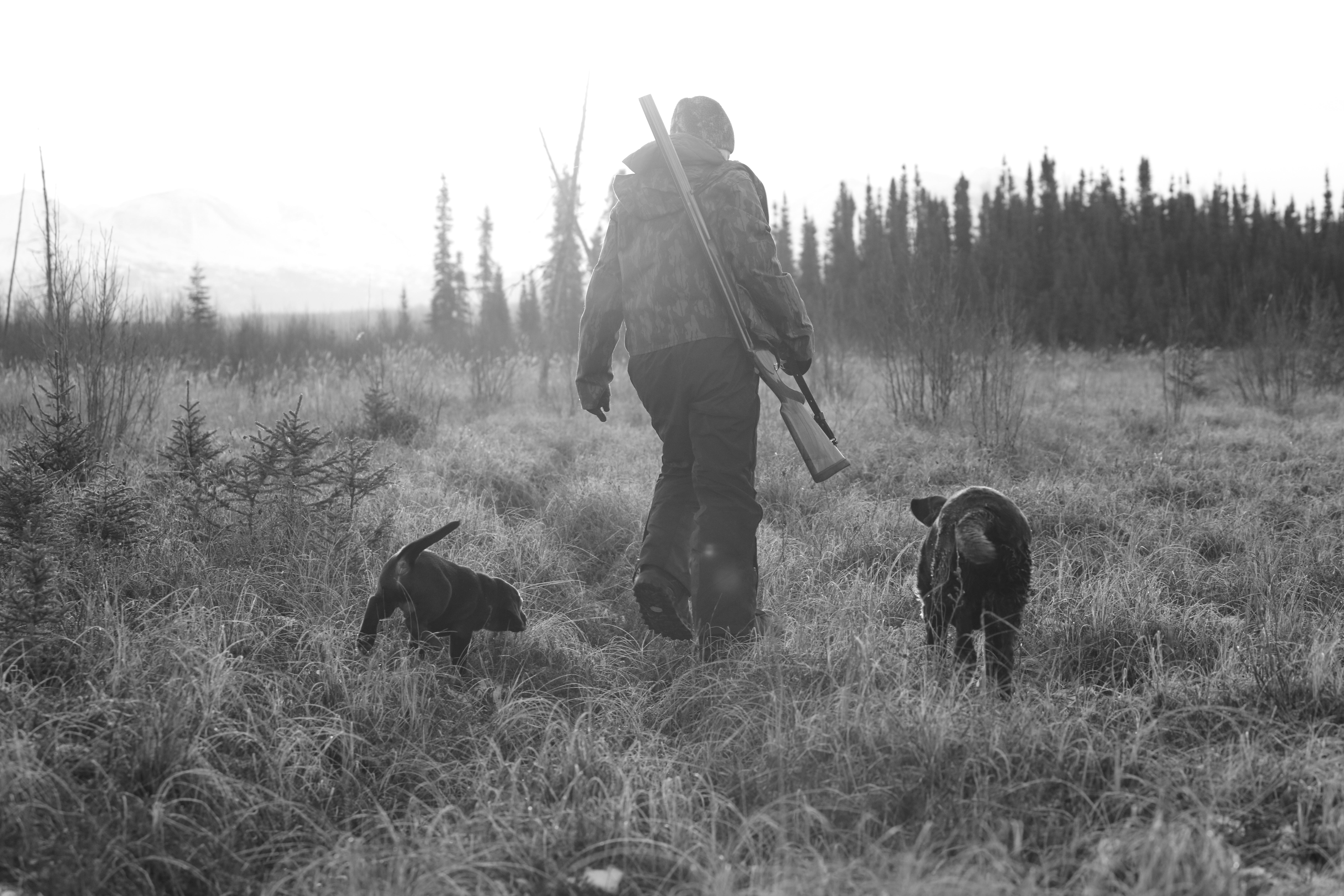
I don’t know if I belong here. Any other September morning, if I didn’t have to be at work, I would be out on the flats. The cold rain and swamp smell would feel like a homecoming as long as a chocolate Labrador ran out into the dark morning beside me, sharing the joy and aliveness that comes not from bracing yourself for misery but from opening up to it.
Rigby was born in September, five years ago, and he joined Steve and I in the field as a chunky pup I often carried while Cheyenne, one of the best duck dogs I have ever loved, ignored us in her pursuit. She was small for a Lab, not what some would call a ‘pocket lab,’ because no one could put Cheyenne in a pocket, and she had eaten through most of ours anyway. She loved to hunt and retrieve ducks.
After Cheyenne passed away, Rigby became our duck dog. He is also a chocolate Labrador, but of the English variety, which is to say that he is rather large and wide set, weighing in at 109 pounds for his last appointment. He has the most wonderful underbite that pushes out his bottom lip. It’s not a toothy underbite, just enough to give his protruding jaw a resolute plumpness and softness that makes you want to grab both his ears and kiss his face in a completely motherly way that in no way makes you a “crazy dog person.”
His hunting style was unlike Cheyenne’s in almost every way imaginable. Cheyenne was itchy in the blind, making impish chirps and glancing at you as if she were a child on Christmas morning waiting for the signal to open presents and mistaking the signal as given at any moment. When she marked a fallen duck, she ran to it without once looking back, even if she had to search—she didn’t want your help. This was the stage of her life, where she showed all of herself. I loved to watch her intensity and often thought, that’s my girl, my little ducker. When she brought back a duck, she walked around me with the duck in her mouth at least three times as if the crowd were going wild. The crowd was Steve and me, and it was the best of times for us.
Rigby loves the wet world of the flats and being out there with us, but he does not have the same interest as Cheyenne. He will take a nap in the blind, and he behaves as if retrieving is a team activity. For example, he will amble out as if to retrieve and stop to look back as if to say, “Are you coming? Let’s go find this duck.”
Most of the time, contrary to any written advice on the subject, Steve and I will join him, each of us pointing as we walk. Steve likes to say that I retrieve Rigby’s ducks, which in practice looks like me finding the duck and Rigby being delighted to pick it up and then drop it again or, if it is in water, for Rigby to swim out and perhaps in circles while I point from shore, until he finds it with a burst of joy (“We found it!”). Steve has even waded out into a small lake as I watched Rigby swim beside him and enjoyed this uncharacteristic partner method for water retrieves.
For some of us, a hunt has not ever been about technical proficiency, but a way to share a deep love of being alive, with all that life and death entails.
There is nothing I love more than going out for ducks with Steve and Rigby. It is part of so many other days and times when we may have gotten an earlier start before we had dogs, sat and watched the tide with Gunner, crawled through the grass with Cheyenne, or wished we were back there so many more times than we get to go.
All of this is to say, I belong out on the flats, and so does Rigby.
He still has a shaved band around his front leg from his first appointment last week. The medical notes say, “We are going to just give Vincristine this week and see how Rigby is doing next week.”
When Steve took the bandage off, and I saw the shaved leg, my stomach turned. It would be a constant reminder that things were not normal, not that I need a reminder.
One night in late August, I noticed Rigby standing next to the kitchen table. It seemed odd. He is usually either excited about food or a trip to town or he is flopped in a dog bed, positioned like a tipped cow on the tile floor, or draped across my lap in the recliner and providing the best weighted therapy blanket I have ever known.
He doesn’t normally just stand there with a vacant stare. I walked over to him, and said, “Hey buddy, what are you doing?” He didn't respond.
“Something’s wrong,” I said to Steve, and he agreed.
A day later, we were in the exam room watching a vet feel him all over. This vet, who was not Rigby’s regular vet, had asked me to put a muzzle on him because he had growled at her. I couldn’t help feeling like I had to explain that he wasn’t properly socialized as a pup due to his being born during COVID-19. He is a good boy, and he has made friends with new people and dogs since, it’s just, he is on edge when things are weird, and this was weird.
She didn’t feel an obstruction and she moved to his hips, articulating the joints. “Do you hear that?” she asked. There was a click in his right hip. She made the noise several times so that the technician, Steve, and I could each separately agree that we heard it and then once more so she could hear it again. I was paralyzed by politeness, and wanted to say, “Can you stop clicking his joint now for crying out loud we heard it.” But, I just sat there holding my breath wishing she would stop.
She prescribed Rymadyl to address the inflammation in his hip and asked us to monitor him closely. If he stopped eating or vomited, we could bring him back in. It didn’t feel right.
A few days later, Steve brought him back in and asked for an x-ray and blood tests, not because he stopped eating or vomited, but because nothing had changed. Something was wrong.
Steve brought Rigby by my work office with the results. The x-ray showed two things. First, Rigby had hip dysplasia on both sides. Second, he had a large mass near his heart. The vet suggested taking a sample while Rigby was sedated for the x-ray, and this was sent off for testing.
That Friday, two days before the opening of the waterfowl season, I got the call that the sample said the mass was a lymphoma. “Do you know what that is?” the vet said.
I had been searching the Internet and had hoped the mass was an imaging mistake or thymoma, a mass that is less likely to metastasize and not lymphoma, an aggressive cancer that affects the lymphatic system. Rigby’s bloodwork showed that his calcium was high, which happens with lymphoma. “It’s a common big dog cancer,” the vet went on to say. There was not a vet oncologist in Alaska, but there were two options for chemotherapy treatment—one in Palmer and one in Anchorage. Both coordinate with an out-of-state oncologist. “We are trying to get remission,” the vet said. “You just want the longest remission.” Then he said some remissions can be over a year.
After I hung up the phone, I stared at my work desktop in front of me. I stared like Rigby had been staring. Now I knew what he knew. Something was wrong. His young life was being shortened.
We stayed at home on opening day, and I listened to Rigby snore. His breathing was louder, possibly due to the mass near his heart affecting his lungs. I listened to the rain on the metal roof and the snoring. What else could so perfectly express how I feel?
No words my friend. I’m glad you’re here, and sharing. Traversing with you and yours. 🫶
Such presence in this work… 🙏🏾