
Promise Me

The subject of bird hunting, if it is a thing and not a living, breathing organ of my life, is one that I dare not think about too often lately.
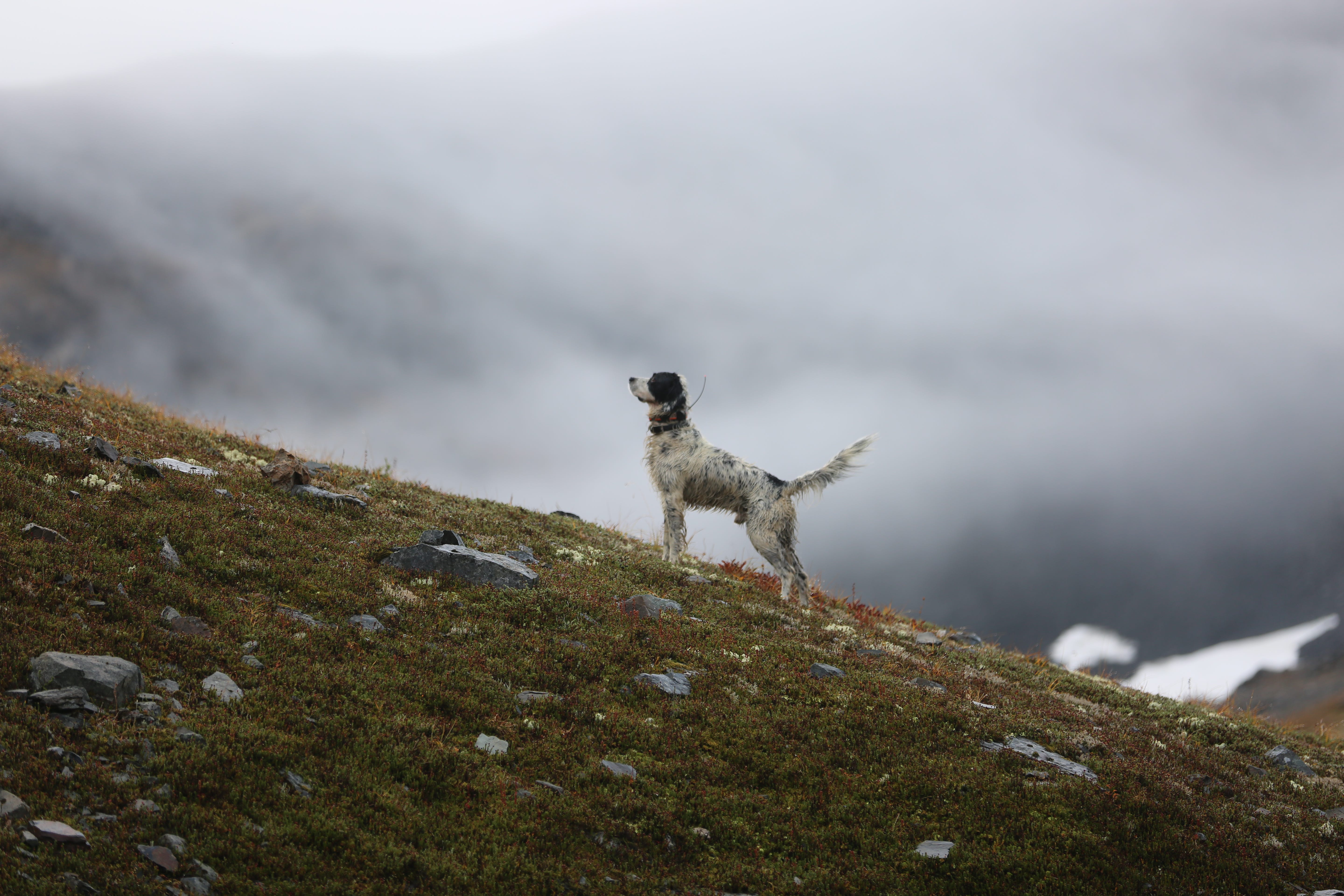
My thoughts tend to frame subjects as a treatment of the past, a record of the present, or an image of the future. But my mind is haunted by feelings and locks up on ghostly images: three setters slicked with fog on a rocky plateau inching toward a small group of white-tailed ptarmigan. Later, on a mountainside, I sit with the white body of a bird, warm and bloodied in my hand, with the feeling that I am holding my own heart, and I wonder if I could ever kill another bird.
These images are not subjects. Not things. They do not make for polite conversation. If someone asks me a practical question about how to get started bird hunting, I don’t mention this, but it is there in my mind, along with the image of a smiling, athletic English setter in his prime. Winchester or Hugo’s joyous and open run in the high country, covering miles while I look on, dazzled by the brilliance of the country and the magical light of our collective best days together.
“You get a bird dog,” is how I answer the question of how to start.
You get a bird dog, and you follow that dog with all your heart. And I specifically don’t say that one day you will be on the side of a mountain, feeling that you are holding that heart, and that isn’t even the worst of it, because eventually you will have to say goodbye to the dog that has taught you everything you know about bird hunting besides how to shoot a gun.
That will come later, after the pain is worth all the joy.
Last week, I found myself at a gun range where a small group of women gathered. They all had bird dogs, although not with them that day, when they were learning about shotgun work and what to expect as part of a months-long lead-up to their first bird hunting season.
The woman leading the group asked them to promise not to yell at their bird dog on the first day afield. She explained that they would lose their voices trying to restrain the unbridled enthusiasm of their dogs. “Let them get it out of their system,” she said.
It may not be polite to eavesdrop, and so I moved along, thinking to myself, Winchester never got it out of his system. It was his system.
Bird hunting. To some people, it conjures images from old magazine covers – the rising bird, large in the foreground, the dog on point in the midground, and the small man in a plaid shirt with a raised shotgun in the background. This is not the point of view in the field.
Most of my remembered images are of dogs in motion while I am on a long march behind them. Whatever is in the dog’s system that makes him run that wild and free, I wish I had it in my system.
If it’s in my blood to yell, I might yell that it is so goddamn beautiful.
Besides, I am more of a crier than a yeller. I’m more apt to cry out questions to the gods: Why am I crouched on a rocky precipice when I am afraid of heights, and Hugo is over the next ridge, flushing birds? How did I get myself here? What am I going to do? Is helicopter rescue an option? Is that bed of lichen below me likely to be soft to fall into or a thin veil over shale?
Winchester and Hugo both learned how to hunt on wild birds. Though at first, Steve and I tried to show Winchester how to do it the human-structured way: we took him to a game farm, put chukars to sleep, and planted them in the field. His response was lackluster.
If he were a human, his game farm point might have looked like a school boy raising a limp hand to indicate he is present. If his body could talk, it said, “Here are those sleeping birds that smell like you put them right here where you are looking.”
It was not the serious point that I came to love seeing in the mountains. The point that had his entire body gripped with purpose, thrilled by life.
I’ve been around other dogs who love to find any bird – pen-raised or wild, sleeping or awake – just like there are some people who love to shoot clay pigeons on the trap range and pheasant in the field in equal measure, even if different. But that wasn’t Winchester’s way.
He loved to hunt wild birds. And that’s what he did best.
Early in his hunting days, Steve and I followed him into the mountains, and I spotted two willow ptarmigan right off the trail. We hadn’t yet reached treeline and broken into the country, as Steve called it. Winchester had run by the birds.
“Steve,” I said, “There are two willow ptarmigan right there.” I pointed to them, as if I were the bird dog. “Should we call Winchester back?”
“Maybe they’ll be there later,” Steve said. I was a bit surprised, as it was early in my upland hunting days as well. I thought we were bird hunting, and here were the birds.
It’s clear to me now. It’s clear to me what Steve means when he says, “Winchester’s birds.” Or “Winchester’s mountains.”
We were hunting Winchester’s birds. There was no point in pretending that it was a team effort in which we all played multiple roles. He might as well have told me to “Stay in my lane.”
Other hunters might do it differently. They might have a dog who appreciates a little help and guidance. Some parties can stand multiple pointers.
Rigby, the Labrador, loves all the help he can get finding a duck, and I don’t mind being out in the water with him in my chest waders, even if that’s not the traditional way it’s done.
If you’re ever with a dog who is master of his territory, you don’t question his work. If he wants to pass by willow ptarmigan along the trail, you don’t figure the wind is wrong, and maybe help him circle back.
“Let him work,” is our motto.
I don’t need the birds for the pot – it’s true what some people who are against hunting say. Most of my food comes from the grocery store. What I do need is to be a part of the life cycle in a way that is true and good from time to time. Even if I live in a world that shows me every day that I can survive in a fluorescent-lit box, eating Soylent Green rations. I need to be honest, even when it hurts.
Winchester’s birds were the highest, farthest birds, always just over the hill you didn’t think you could climb. Just over the rise that opened into the most splendid view you’ve ever known. He made you work to keep up with him, to go at speeds and heights that forced you into a different world than you had ever known. He took you into the world of birds, their home in the mountains, his heaven.
Some say hunting requires cognitive dissonance, a way to hold two contradictory beliefs as true – you love birds, you shoot birds. And you don’t have an industry staffed by hundreds of people operating machines between these truths to square and label the meat in Modified Atmosphere Packaging.
You have a sacred pact with yourself to follow a certain set of rules, you don’t take too much, and you follow the dog, you chew your meal slowly. Bird hunting becomes more than the sum of its parts. It becomes the fusion of interdependent forces – birds, dogs, country, humans.
The relationship is not complicated except when my human heart intervenes to understand, to be a part of such a wild world, to try to live beside, within, and beyond greater forces than myself.
I try to make out the shape of what is to come after those days on the floor with a puppy, those days in the field with a friend like no other, the bird in your hand, and a sloppy-jawed soulmate at your side, tongue askew and rakish. You, with your well-worn gear and gun, smiling for a photo you can’t bear to look at these days because you were so happy then, and now you’ve lost the loves you came home to, and went on adventures with and you don’t know what is next.
And just when I wonder if I have lost my mind in grief, I stumble upon true words of advice from a woman teaching other women that is too good not to share.
Promise me you won’t yell at your bird dog.
One of the most enjoyable things in my memory is when I have shot at a bird the dog has flushed and miss and the dog turns and looks at me. If She could talk I can imagine she's saying something like dumb s*** I did my part.
I promise. Every bird dog is different. How they look at a field or a mountain. How they look at different birds. Some don’t need you at all, except to shoot the bird. Some need more handling to get there. But all the bird dogs I’ve owned loved life and loved what they do. They could be dying of cancer and on death’s door, but they are still looking for that joy of the hunt. And that stink eye when you miss the shot. Love bird dogs and what we do together.