As Useful As the Light

If you are lucky enough to be rescued by a dog, you might feel a debt that you can never repay. You might not have deserved to be rescued, and you may feel that the story is no longer centered on you. Afterall, you may be like cod lashed to a piece of wood and set afloat in the sea for a good dog to find and bring home for a reward. You might have fallen in a well or been trapped on an ice shelf in the Swiss Alps, or more likely, you were just a regular person in our modern world, going about your days like I was. You might have felt a growing sense of loss – whether it was because you had gotten to the age where you questioned your life, lost a few good friends, or looked out at the Cook Inlet on your drive to work one morning with a sense that the entire world was sickening and you were sickening with it.
(That’s how it is when you are driving by the ocean instead of heading out in it).
Maybe, it was early March when you first saw a moose calf along the highway, and saw him again each morning on the way to work. You saw that he was having difficulty finding food, growing weaker, until one morning he laid down. The next morning, he was in the same spot, not having moved. A few miles down the highway, you pulled over and cried. It wasn’t just because of this young animal’s death. It was because everything felt like it was dying and, if not dying, struggling and suffering. You might have wondered if you would ever feel safe and happy again if it was at the expense of so many who will never see another summer day. It was all so heavy.
“Lighten up,” someone told you, which is never helpful. Cheer up, calm down, the feeling passes. My reason for sharing this bit of misery is not because it was a big misery – while the moose calf faced the end of his life, my circumstances were trivial. I was not thrown overboard on a fishing vessel, trapped in an avalanche, or starved and cold next to a highway with thousands of people driving by me on their way to work. I could not rescue the moose calf because I didn’t know how, didn’t know if it was even legal – the wild must stay wild, despite our paving over it. No one could rescue me because nothing in my life warranted a rescue effort.
I bet few suspect a girl in their office who has showered and showed up for work, dressed appropriately, and doing a good job is silently falling apart, warrants any attention. Even if you see her car parked behind Safeway because that day the thing that made her cry was watching two ravens fight over a piece of discarded garlic bread.
But somehow, back in 2020, as COVID expressed itself as a masked scream, an expression of mass human sickness, isolation, and alienation, you might have had a moment where you looked down at your phone and saw a text from your partner. He had been looking at Labrador puppies, and sent you a message: “We’re going to meet Rigby tonight.”
Rigby, a four-week-old very plump chocolate Labrador pup, saved me. Just to see him made me feel like my heart opened up. I felt like I could breathe. I smiled, laughed. I felt all of my bodily aches, mental anguish, and spiritual woes suspend. There was only this beautiful, adorable, delightful little creature. Just the sight of him was pure joy. We took him everywhere with us, and five years later, he is still as wonderful as he was on that first day.
That’s what I mean when I say he rescued me. I was at no risk of harm to myself or others. All scientific measurements of my physical, mental, and even spiritual state had been checked out by professionals. Some of the kindness people I have ever reached out to for help assured me that I would be just fine. They said this even as I despaired and they could do nothing to help me. But Rigby, just by virtue of being himself, kindled a spark of joy. The spark that can keep you alive no matter how dire or mundane your circumstances.
He is just a dog, as they say. In common usage, the word “just” as an adverb so often means “merely” – “just a flesh wound” instead of exactly or quite. In common language a rescue dog is one that a human saves from a perilous situation or who is trained to “search and rescue.” When a rescue dog also rescues a person, the story is “just” another ordinary story of civilization meeting domestication in our all too human world even if, for those involved, even without formal rescue, the sudden meeting of two random souls can be lifesaving.
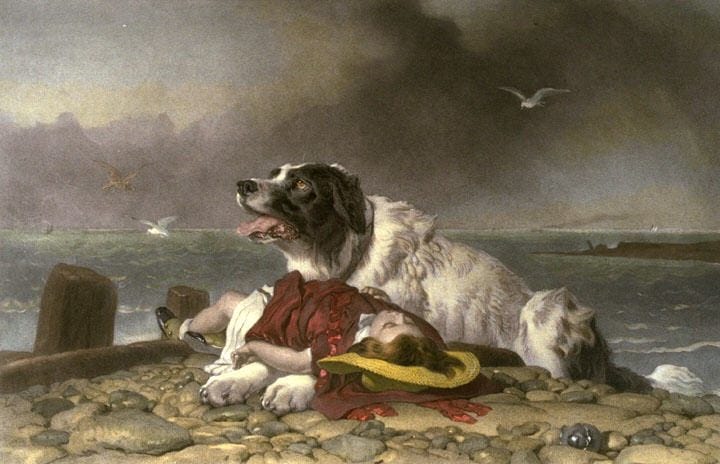
I prefer to think of rescue as epitomized by a Massachusetts dog named Milo who lived at Egg Rock’s first lighthouse along with its keeper, his wife and children, chickens, goats, and a tame crow. Milo was famous for the rescue of several children as depicted in Landseer’s painting “Saved.” The keeper claimed his dog was “as useful as the light.”
I prefer to think of rescue, not as a single act of valor in the face of peril but as any variety of expressions of and encounters with the beauty of life, such as seeing a sunrise or a sunset, in which no matter how much we rely on each other or wall ourselves into dark places, there is an ever present light that contains not just warmth but a need to connect with other light, to crack open the shell, as the mystics might say.
If you are lucky enough to find this connection – call it love, call it duty, call it anything but another blind drive to work in traffic for a day at the office – you will, in turn, find yourself wanting to return the gift you were given. And so here you are, with me, wondering how to face the complex task of taking your hero, the one who carried you through stormy seas in strong jaws with the biggest paws you have ever seen, to his chemo appointment.
You will be here with me, with a lump in your throat in front of a screen as the big lug of a dog, kind-eyed, sweet-souled, sleeps after a good breakfast, wondering what else you can do for him. Because we are all still living in that broken world that attempts to cure every uncured malady. Instead, perhaps, of resting on the shore together in realization that, for at least this moment, we have been saved.